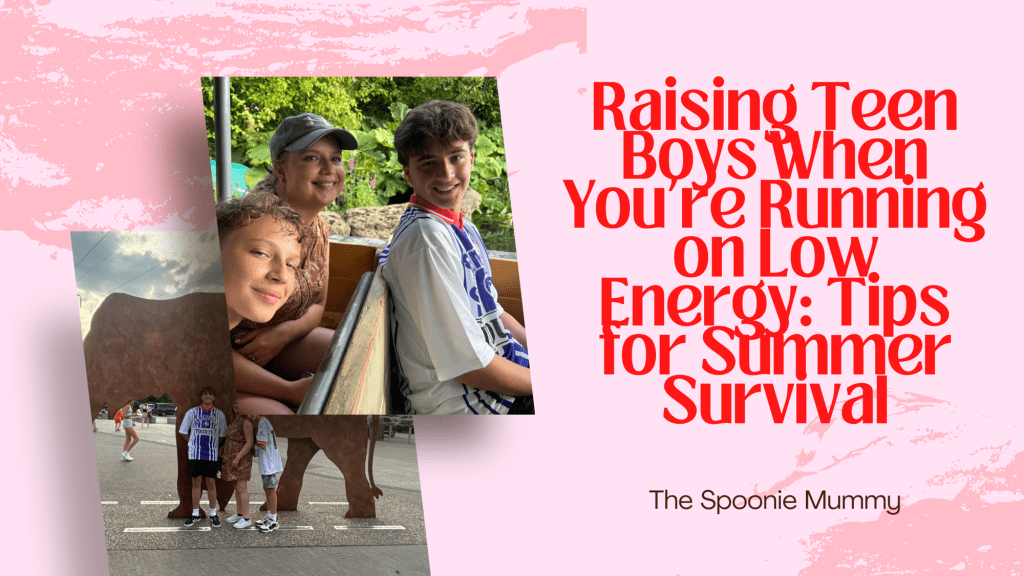
Summer with teenagers often brings a mix of freedom, frustration, and fatigue — especially when you’re parenting with a chronic illness. If you’re anything like me, the warmer months can feel like a double-edged sword: your kids are home more, but your energy is stretched thinner than ever. And while social media might be showing elaborate beach days and endless adventures, the reality for many of us is different — slower, quieter, and more survival-mode than sunshine-filled memory-making.
But here’s what I’ve learned: you don’t need boundless energy to raise good kids or create meaningful memories.

Especially when you’re living with conditions like adrenal insufficiency, Crohn’s Disease or juvenile rheumatoid arthritis (or parenting with an ileostomy), it becomes essential to parent within your energy budget — not in spite of it.
So today, I’m sharing some honest, practical, and grace-filled tips for surviving — and maybe even enjoying — summer with your teenagers when you’re running low on energy.
Accept Your Energy Reality
First things first: you can’t give what you don’t have. That means acknowledging your limits and planning around them instead of pushing through. Chronic illness often comes with unpredictable energy levels, and what works one day may not work the next. That’s okay!
Think of your energy like a bank account: every task — even small ones — makes a withdrawal. Overdraw, and you’ll crash. The key to surviving summer isn’t doing more with less — it’s doing what matters most, and letting the rest go. Remember that they might also need the odd PJ day – long terms and hard work can leave them needing a good rest day or two as well!
Read my post: So What Is A Spoonie? for more info on the Spoon Theory
Set Expectations Together
Teen boys are more perceptive and capable than we often give them credit for. You might say:
“Hey, this summer might look a little different. My energy is limited right now, but I still want us to have a good few weeks together. Let’s make a plan that works for both of us.”
With my boys I’ve talked about things they wanted to do, things I could reasonably manage and I built a flexible routine around this. This helps them feel included and respected — and helped me avoid guilt or burnout from trying to keep up a pace I couldn’t sustain.
Tips:
- Create a “good days” list and a “rest days” list of activities.
- Set boundaries early (like daily quiet time or screen-free dinners).
- Be honest about how you’re feeling day to day — it teaches emotional openness.
- If you have a big day out planned ensure theones before and after it are easier ones.
Embrace Low-Energy Ways to Connect
Let’s be real — you don’t need to hike mountains or go on big outings to bond with your kids. In fact, some of the most meaningful moments come from the simplest things, like:
- Watching a show or movie series together (we have done Stranger Things, Cobra Kai and are currently working our way through The Inbetweeners)
- Listening to music, audiobooks, or podcasts while you rest
- Taking slow walks or sitting outside with a drink
- Playing a casual video game or board game
- Cooking something easy together
- Going to the local park and letting them play while you sit and watch
- Meet up with your friend and their kids. My best friend ha been there for me for over 20 years. We get together and the kids can have fun together while we grab a cuppa and chat!
The key is being present. If you’re engaged (even from the sofa), your teens will feel it.
Enlist Their Help Without Guilt
Teen boys are learning what it means to become adults — and part of that is stepping up. Helping out at home isn’t just practical for you; it’s good for them.
Start small and give clear instructions:
- Ask them to help prep dinner once or twice a week.
- Set up chore rotations or room-cleaning check-ins.
- Let them take responsibility for planning one fun thing a week.
Have Real Conversations About Health
Summer often gives us slower mornings or quieter evenings — and those are perfect times to open up about what it’s like to live with chronic illness.
I’ve learned that sharing my reality (in age-appropriate ways) builds empathy, patience, and even gratitude. It also models strength and vulnerability — two things we all want our boys to learn.
Topics to touch on:
- What your condition means and how it affects daily life
- How they can help — and why they don’t need to “fix” you
- Why rest is necessary, not optional
- What resilience and self-care really look like
It’s not about burdening them — it’s about helping them see you as a whole human being.
You’re Doing Enough
If you’re parenting through pain, fatigue, or any chronic condition, please hear this: you are doing more than enough.
Your teens don’t need a perfect parent — they need a present one. And presence can happen from a chair, a bed or a blanket on the grass.
There will be lazy days. There will be frustrating moments. There will be times when you feel like you’ve done nothing at all. But to your kids, you’re still showing up. You’re still loving them and that’s the part that counts!
💬 Have any tips for parenting during the Summer with a chronic illness that I missed? I’d love to hear from you in the comments below!
I hope you are enjoying your Summer break,

 The Spoonie Mummy
Leave a comment